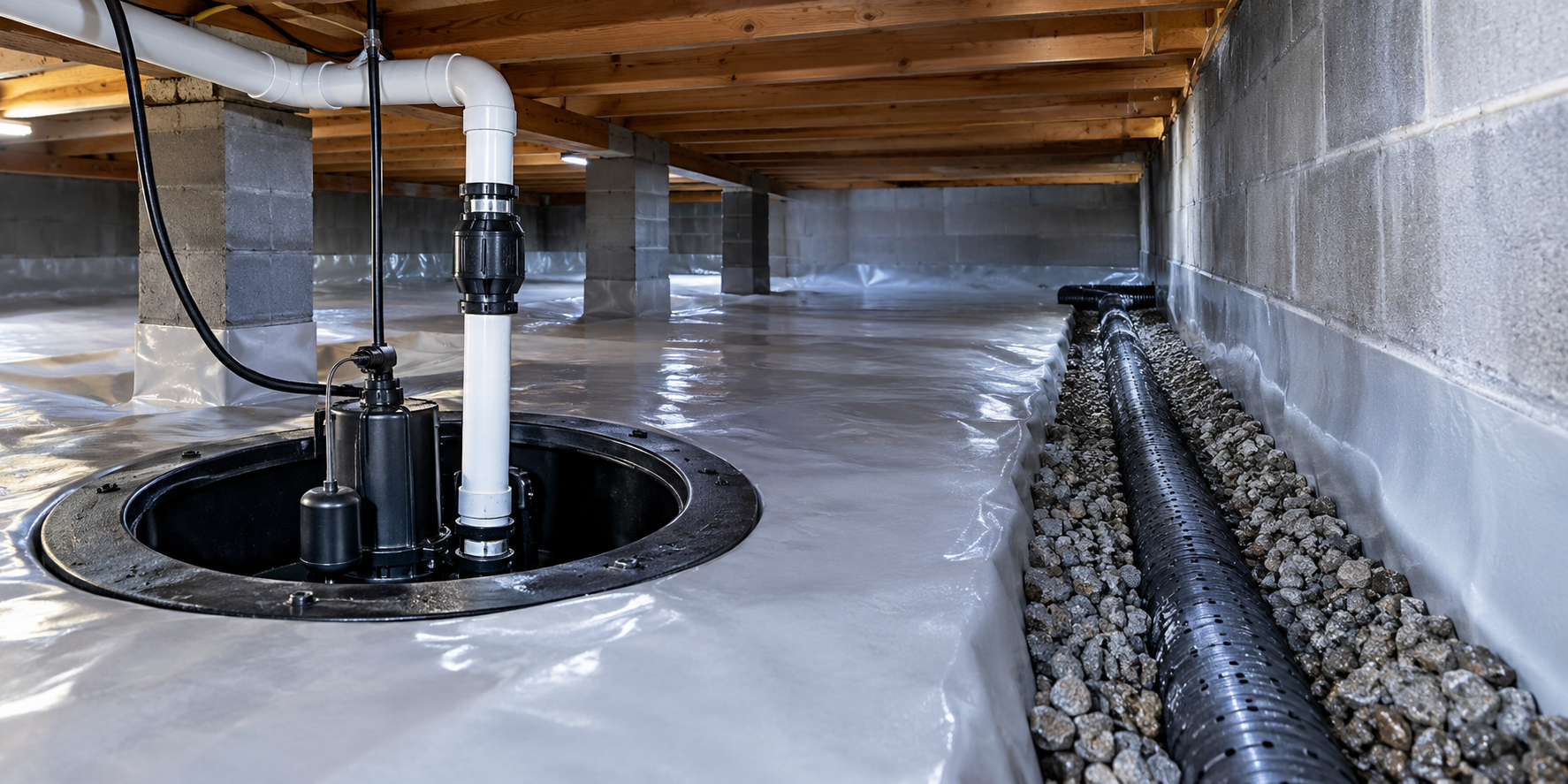
What Crawl Space Encapsulation Costs in Virginia Beach
Ask three contractors for a quote and expect three different numbers. Sometimes wildly different. One shows up at $3,500, another walks the same crawl space and writes down $9,000, and there's rarely a good explanation offered for why. Most homeowners never get told what goes into crawl space encapsulation cost Virginia Beach before they're asked to sign something.
Part of the confusion is that contractors don't always explain their math. Square footage matters. So does how wet things are down there, and what shape the framing is already in.
There's more detail on what a standard job typically covers on the crawlspace encapsulation services page, worth a look before comparing quotes side by side.
Why the Price Swings So Much
No two crawl spaces are the same, so a flat number rarely means much on its own. A crawl space with standing water and rotted framing needs drainage work, some structural repair, and encapsulation, all stacked together. That's a bigger project with real labor hours behind it. A dry crawl space that just needs a vapor barrier and some vent sealing is a lighter lift, and the price should reflect that.
Quotes given over the phone without anyone setting foot in the crawl space are basically guesses. Sometimes the guess is close. Often it isn't, and the homeowner finds out the hard way once the crew shows up and the scope changes.
What Pushes the Cost Up or Down
A few things tend to decide where a quote lands:
Square footage plays a big role. Anything under 1,000 square feet is usually on the cheaper end, while spaces over 2,000 square feet push costs up fast.
Moisture matters too. A crawl space that's dry to begin with costs less to encapsulate. Standing water or active leaks add cost almost immediately, since drainage becomes part of the job.
Vapor barrier thickness is another factor. A basic 6-mil liner is the budget choice. A 20-mil reinforced liner runs more but holds up a lot longer, especially in a humid climate.
Insulation is optional in some quotes and not in others. Skipping wall insulation keeps the number down. Including it adds cost but usually pays off over time.
Drainage is a big swing factor. No drainage needed keeps things simple. A sump pump or French drain system adds a meaningful chunk to the total.
Access counts more than people expect. Easy crawl access keeps labor costs down. A tight, cramped, or obstructed crawl space slows the crew down and the price climbs with it.
Most homes around Virginia Beach fall somewhere in the middle of all that. It's part of why quotes here cover such a wide range. Older homes, and anything close to the water, tend to need drainage work folded in, and that's usually where costs jump the most.
What a Full Job Includes
Say "encapsulation" to most people and they picture a plastic sheet on the ground. And indeed, that’s part of it, but a professional job encompasses much more than that. A comprehensive scope of work involves removing all the old debris and any degraded insulation, weatherstripping the vents as well as the rim joist area, installing a vapor barrier on the floor and walls, and installing a properly sized dehumidifier.
Skip any one of those steps and the whole system suffers. A vapor barrier with unsealed vents still lets humid air sneak in. A dehumidifier working against a weak barrier just runs constantly for little payoff. Two quotes can carry the exact same price tag and still deliver very different results, depending on what's included, which is why it's worth asking a contractor to walk through the scope line by line instead of just comparing the bottom number.
What Homes in the Area Typically Pay
A complete job, including vapor barrier installation, sealing, and dehumidification, is likely to cost somewhere between $5,000 and $12,000 for a standard Virginia Beach house. With the addition of structural work, sump pump installation, or dehumidifying equipment, the price may be driven well above $15,000 without much difficulty.
Anything less than $3,000 requires a closer look. That price almost always means a thin liner going down with no sealing at the vents or seams. It might hold up fine for a season or two. Then moisture finds the gaps, the way it always seems to, and the whole job ends up getting paid for twice.
Paying for the Job Without Draining Savings
A number in the five-figure range isn't something most people have sitting around, and that's normal. A lot of homeowners in Virginia Beach end up looking into crawlspace repair financing instead of paying the full cost upfront, especially once structural repair or a sump pump gets added to the scope.
Most reputable contractors offer some kind of payment plan, whether that's an in-house option or a partnership with a third-party lender. Monthly payments tend to make the decision a lot easier, particularly when the alternative is putting off a repair that's only going to get more expensive the longer it sits.
Check out the financing options page for a breakdown of what's typically available before assuming the full cost has to come out of pocket at once.
Getting a free crawl space inspection Before Any Number Gets Written Down
An in-person look at the space beats any price comparison. A short list of questions makes it a lot easier to tell a fair quote from an inflated one, or one that's cutting corners nobody mentioned out loud.
- Push for an in-person inspection before accepting any price. Phone estimates aren't worth much.
- Get the vapor barrier thickness written down, whether that's 6-mil, 12-mil, or 20-mil.
- Confirm whether the quote covers vent sealing and rim joist insulation, not just the floor liner.
- Ask whether drainage or a sump pump is already baked in, or billed separately down the road.
- Get warranty terms in writing, along with whatever could void them.
- Line up at least two quotes, both based on someone walking the space in person.
Red Flags Worth Watching For
A price that seems too good usually is. Vague language like "vapor barrier included," with no thickness mentioned anywhere, is one warning sign. No mention of sealing around vents or piers is another. A warranty that only covers materials, leaving labor out entirely, is a common gap that's easy to miss on a first read. A contractor who won't walk the crawl space before quoting a number is one worth crossing off the list.
Frequently Asked Questions
Is dehumidification included in the cost?
That depends on the contractor. Some contractors include the dehumidifier in the package while others charge for it additionally. Good to ask about it in order to avoid any unpleasant surprises at the bill.
Does encapsulation result in reduced utility bills?
Quite often homeowners have a chance to save some money on their heating and cooling expenses thanks to the fact that the crawl space stops drawing moist air in from outdoors. The amount depends on the insulation of other parts of the house.
Is the cost of the procedure justified?
Definitely, if your house experiences problems with humidity, wood decay or mold odors that keep coming back. It will preserve the building and will cost less than repairing the damages caused by wood rot or mold.
How long will it take to install the system?
Generally speaking, it takes one to two days.
Is there ever coverage under insurance for the cost?
No, unless it's somehow related to water damage, which may be covered under insurance. Most individuals have to pay out of their own pockets for the service or take out loans.
Does a crawl space inspection cost anything?
No. Coastal Crawlspace Solutions' crawl space inspection is always free, with no obligation to move forward with any work.
Is "crawlspace encapsulation cost" the same question as "crawl space encapsulation cost"?
Yes — both refer to the same service. A complete encapsulation typically costs $5,000 to $12,000 for a standard Virginia Beach home, depending on size and condition.
The number provided in any estimate says very little about the whole deal. The thing that really counts comes after that number, like the strength of the membrane, vent sealing, drainage, and even a warranty on the labor as well as the materials. Just a few visits and some smart questions can tell you more than any cost analysis ever could.