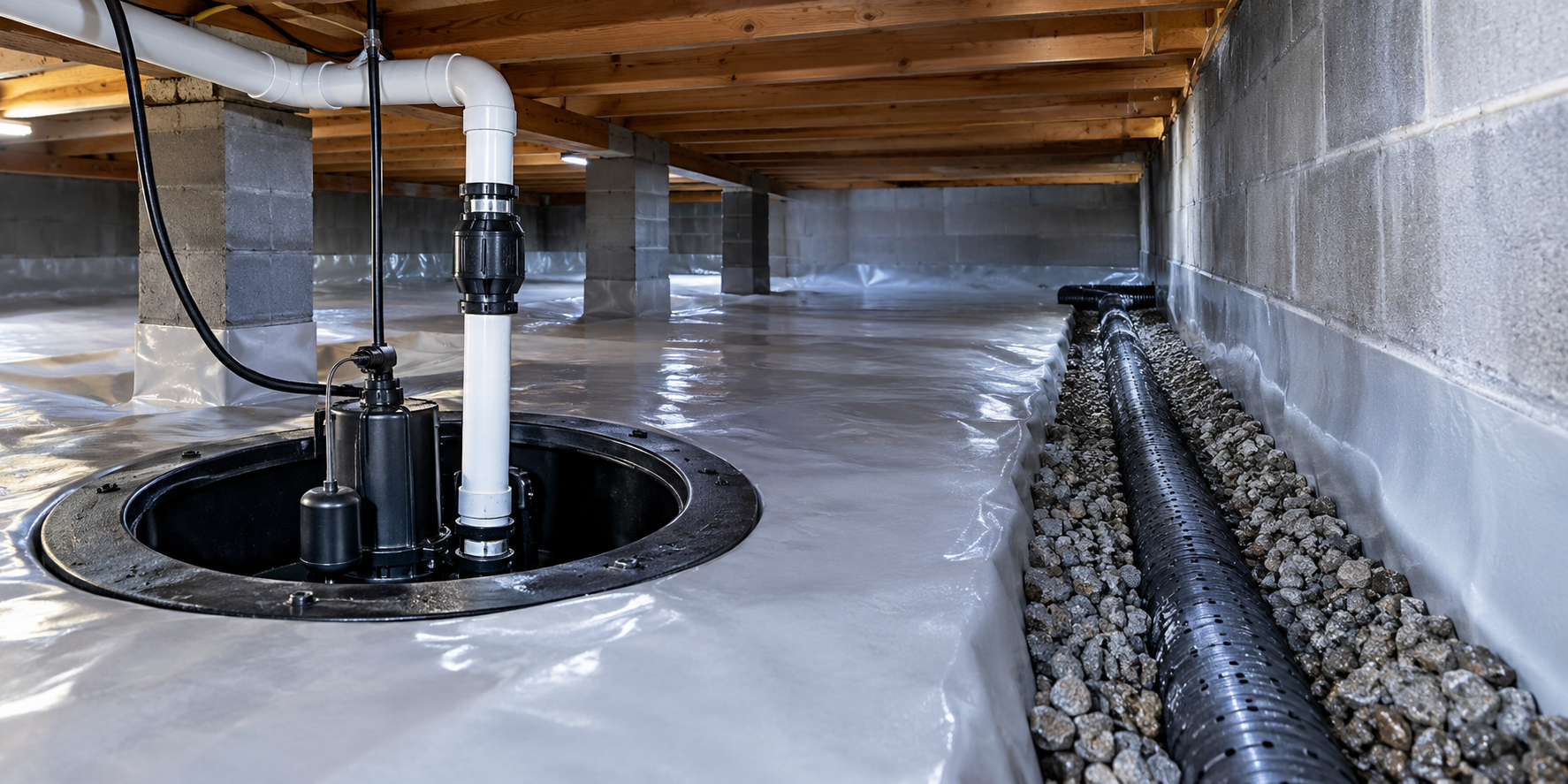
The Long-Term Structural Damage Caused by Ignoring Crawlspace Standing Water
Nobody calls a foundation company because their crawl space smells a little musty. They call because a door upstairs suddenly won't close right, or a floor near the kitchen has started to bounce when someone walks across it. By the time those signs show up, the real problem has usually been sitting under the house for a year or two already, quietly doing its work while everyone upstairs went about their normal life.
That gap between cause and symptom is why so many people searching for crawl space structural repair near me are surprised to learn the story started with water they never even saw. Standing water under a house doesn't announce itself. It doesn't flood a room or stain a ceiling. It just sits there, month after month, and the wood, the soil, and the framing above it slowly start losing the fight, one small degree at a time.
We've covered where this water comes from and how to stop it at the source in our water management systems guide, part of the same drainage series this piece closes out. That earlier resource handles prevention. This one is about what happens when prevention doesn't happen, and why the damage that follows is a lot harder to undo than the water problem that started it.
Wood Doesn't Fail Overnight
Here's what a lot of homeowners don't realize. Wood exposed to consistent moisture doesn't rot in a dramatic way. It softens first, quietly, without much of a visible change. Structural framing sitting a few inches above standing water for a year will start losing density long before it visibly crumbles. Press a screwdriver into it at that stage and it might still feel close to normal. Come back another year later, and that same beam can give way under light pressure that wouldn't have bothered it before.
This is usually when a sagging crawl space starts becoming noticeable from inside the house. Floors near exterior walls develop a slight dip that nobody quite remembers being there last year. A door frame that used to close flush now catches on one corner every time. None of it happens fast enough to seem alarming in the moment, which is exactly why it gets written off for so long. People assume the house is settling, the way old houses sometimes do. Occasionally that's the whole story. More often, there's water involved underneath the settling.
The Chain Reaction Nobody Warns You About
Standing water doesn't stay contained to one corner under the house. It moves, it spreads, and it interacts with everything around it in ways that compound over time, one small failure feeding the next.
Take a joist sitting in damp soil long enough. It softens. Once it softens, it can't carry weight the way it used to, so the load quietly shifts onto neighboring joists that were never built to handle the extra strain. Those start sagging too, just on a slower timeline. Meanwhile, moisture in the air under the house works its way up into subflooring, drywall, even the trim work on the floor above. Nobody upstairs connects a slightly uneven floor to something happening three feet below their kitchen, but that's the exact chain playing out in slow motion.
Left alone long enough, this pattern doesn't stop at cosmetic issues. Sustained moisture softens the soil supporting foundation piers too, and once those start to shift even slightly, the whole structure above begins adjusting to compensate. That's the point where a fix stops being a weekend job and starts requiring real structural repair work, jacks, sistered joists, sometimes full pier replacement, and a bill that looks nothing like what the original drainage fix would have cost.
Why This Takes So Long to Notice
Part of the reason this damage sneaks up on people is timeline. A roof leak shows a water stain on the ceiling within days. A pipe burst floods a room within hours. Crawl space moisture works on a completely different clock. It can take a full year, sometimes two or three, before any of the damage becomes visible from inside the living space. By then, most homeowners have forgotten their crawl space ever had a water issue at all, because it wasn't a single memorable event. It was just always a little damp down there, and life kept moving.
That slow build is precisely why stagnant water is more of a threat than many of the more visible problems that homeowners fret about. There is no regular checkup scheduled for something you cannot see and hardly give a second thought to. The damage merely piles up gradually from season to season until some sort of symptom forces the discussion long overdue.
What This Looks Like in a Real House
Picture a typical Hampton Roads crawl space that's had standing water off and on for two rainy seasons. The homeowner never noticed anything under the house, because nobody goes down there without a reason. Upstairs, a hallway floor starts feeling slightly springy near one wall. A kitchen cabinet door stops sitting flush. Small stuff, easy to dismiss as normal wear on an older home.
Underneath, the picture is different. A support beam has been sitting in wet soil long enough to lose real strength. The joists resting on it have started to sag, just a few millimeters, not enough to notice by eye but enough to shift weight onto the joists next to them. Given another year or two without intervention, that slight sag becomes a visible dip, and the repair that would have been a straightforward drainage fix turns into a structural one.
Catching It Before the Structure Pays the Price
The good news is that none of this is inevitable once the water problem gets addressed. A crawl space that's properly dried out and protected can stop the damage from progressing, and in a lot of cases, existing framing can be reinforced instead of replaced, provided the intervention happens early enough in the process.
That's really the point of treating drainage and moisture control as one connected system instead of two separate problems handled at two separate times. Solving the water issue without addressing the environment it leaves behind is only half a fix. Once standing water has been managed, the crawl space still needs to be sealed off from future humidity, soil gas, and seasonal moisture swings, or the same slow damage just starts over again from a different angle a season or two later.
That's exactly where our crawlspace encapsulation services resource comes in. It walks through what a fully sealed and conditioned crawl space actually involves, and why it's the piece that keeps a drainage fix from becoming a temporary one. Standing water gets resolved, the structural risk gets addressed before it turns expensive, and the crawl space itself stops being a recurring source of the same problem year after year. That's the full loop this cluster has been building toward, not just one link sitting at the end of it.