Why Floors Sag in Crawlspace Homes: The Hidden Structural Problems Beneath Your House
Sagging floors almost never come from the flooring itself. That's rarely the real story. In crawlspace homes, a dip or an uneven patch in the floor is usually just what shows up on the surface after something's already gone wrong underneath. The changes build slowly, with no real warning sign, so most people don't catch it until it's already messing with how they use the room.
Catching it early matters. Homeowners who look into crawl space foundation repair as soon as the first signs show up usually skip the bigger, pricier fix that comes later.
Virginia Beach doesn't make this easier. Humidity stays high most of the year, and soil conditions can flip from one yard to the next. Crawlspaces here take a beating from moisture and shifting ground both, and over time that wears down whatever's holding the floor up. Deflection, uneven weight, sagging. It's a slow chain reaction.
Knowing the actual cause isn't just about naming the problem. It's what points you toward a fix that actually holds, and that's usually where
crawl space companies near me come into the picture.
Understanding the Role of the Crawlspace in Floor Stability
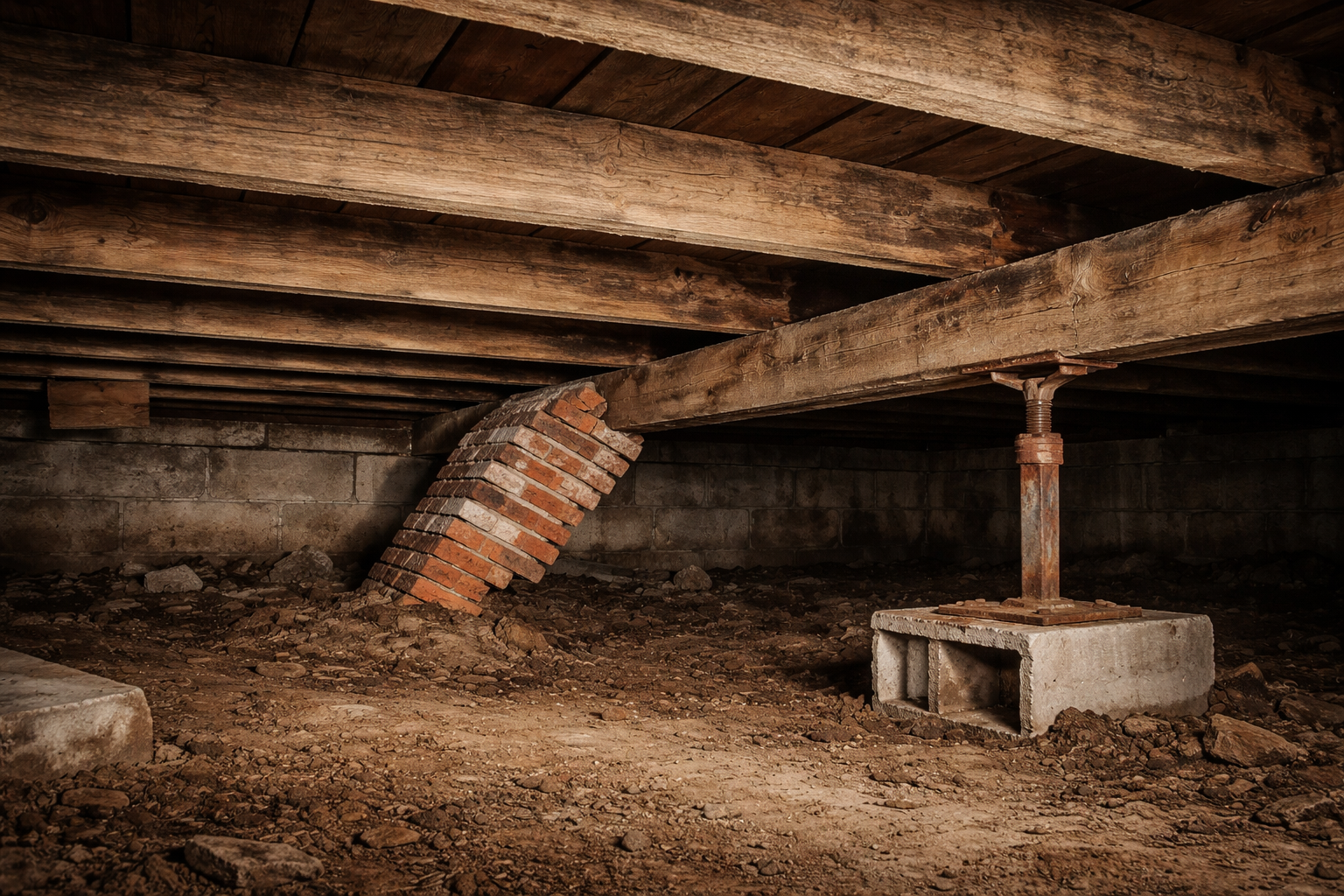
The crawlspace is a critical structural zone. It houses the components responsible for supporting the floor above, including floor joists, beams, and support points that transfer loads to the ground. When these components remain dry, stable, and properly supported, they function as intended and maintain a level floor surface.
However, when conditions within the crawlspace change — particularly when moisture is introduced or when support is compromised — the structural system begins to lose efficiency. This does not result in immediate failure. Instead, it leads to gradual deformation, commonly experienced as sagging or uneven floors.
Because these structural elements are hidden from view, early-stage issues often go unnoticed until they begin to affect the living space above.
Moisture Intrusion and Its Impact on Structural Components
Moisture is the most common contributing factor to crawlspace-related structural problems. In coastal climates like Virginia Beach, vented crawlspaces allow humid outdoor air to enter the space. When this warm, moisture-laden air comes into contact with cooler surfaces within the crawlspace, condensation forms.
This repeated cycle of condensation leads to elevated moisture levels in wooden structural components such as joists and beams. Wood that remains consistently damp begins to lose its structural integrity. It becomes softer, more flexible, and less capable of carrying loads effectively. Over time, this results in measurable deflection.
In addition to weakening the wood, high moisture levels create conditions conducive to mold growth and insulation degradation. These secondary effects further contribute to the decline of the crawlspace environment and can indirectly impact indoor air quality.
Moisture-related damage is progressive. It does not resolve without intervention, and temporary drying measures are insufficient if the source of moisture remains unaddressed.
Controlling Moisture Through Crawlspace Encapsulation
Effective moisture control requires isolating the crawlspace from external environmental conditions. Crawlspace encapsulation achieves this by sealing the space and introducing controlled humidity management.
The process typically includes the installation of a continuous vapor barrier across the ground and foundation walls, sealing of vents and openings, and the use of a dehumidification system to maintain consistent humidity levels. By preventing the entry of humid air and controlling internal moisture, encapsulation creates a stable environment that protects structural components from further degradation.
Crawlspace encapsulation services are not a surface-level improvement. It is a foundational step in preventing ongoing damage and ensuring that any structural repairs performed afterward remain effective over time.
Structural Degradation of Floor Joists
Floor joists are primary load-bearing elements within the crawlspace. Their function is to support the weight of the floor system and distribute loads evenly across the structure. When these components are compromised, the effects are directly reflected in the condition of the floor above.
Structural degradation of joists can occur due to prolonged moisture exposure, natural aging, or inadequate initial construction. In many cases, joists that have been subjected to high humidity levels over extended periods begin to lose stiffness and strength. This results in increased deflection under load.
Additionally, if joists were undersized or spaced too far apart during construction, they may not have been sufficient to support long-term load demands. Renovations that add weight to the structure, such as tile flooring or heavy fixtures, can exacerbate this issue.
The outcome is consistent: the joists are no longer able to maintain a level plane, and the floor system begins to sag.
Reinforcing Structural Support with Crawlspace Support Systems
When existing structural components are no longer capable of carrying loads effectively, reinforcement becomes necessary. Crawlspace support systems are designed to restore stability by introducing additional load-bearing capacity beneath weakened areas.
These systems typically involve the installation of adjustable steel supports and supplemental beams that redistribute weight and reduce stress on compromised joists. Properly installed, they can correct uneven floors and prevent further movement.
Structural reinforcement must be based on a thorough assessment of load distribution and existing conditions. Improper or incomplete support can lead to uneven corrections or continued movement.
Design Limitations and Over-Spanned Floor Systems
In some homes, sagging floors are not the result of damage but of design limitations. Floor systems rely on appropriate span lengths and material specifications to function correctly. When joists are required to span distances beyond their optimal capacity, they are more prone to deflection over time.
This issue may not be immediately apparent after construction. However, as the structure ages and experiences repeated loading, the limitations become evident.
Additional weight introduced through renovations can accelerate the process. Even if the original design met minimum standards, it may not accommodate increased load demands without reinforcement.
Correcting Structural Layout Through Crawlspace Reframing
When design limitations or severe material degradation are present, reframing may be required. This process involves modifying or replacing structural components to meet appropriate load-bearing standards.
Crawlspace reframing services can include reducing span lengths, installing new joists, or reinforcing existing members. It is a comprehensive solution intended to restore the structural integrity of the floor system.
This approach is typically reserved for advanced cases where localized repairs are insufficient.
Soil Movement and Its Effect on Structural Stability
The stability of a crawlspace structure depends not only on its internal components but also on the soil that supports it. In Virginia Beach, soil conditions often include sandy and clay-based compositions, both of which are susceptible to movement.
Sandy soil can shift due to external forces such as water flow, while clay expands and contracts in response to moisture changes. These movements are not always uniform, leading to uneven support conditions beneath the structure.
When portions of the foundation or support system settle at different rates, the load distribution across the crawlspace changes. This imbalance can contribute to sagging floors, even if the structural components themselves remain intact.
Foundation Stabilization as a Long-Term Solution
When soil movement significantly impacts structural stability, foundation-level intervention like foundation repair Virginia Beach VA may be required. Systems such as push piers are used to transfer the load of the structure to deeper, more stable soil layers.
By bypassing unstable surface soils, these systems provide consistent support and prevent further settlement. In some cases, they can also correct existing displacement.
The Role of Water Intrusion in Accelerating Damage
In addition to airborne moisture, groundwater intrusion presents a significant risk to crawlspace environments. Water can enter through foundation walls, poor drainage conditions, or heavy rainfall events.
Unlike humidity, standing water introduces continuous saturation, accelerating wood deterioration and soil instability. This can lead to rapid progression of structural issues.
Effective management requires both removal of existing water and prevention of future intrusion.
Crawlspace Drainage Systems for Water Management
Drainage systems are designed to control water movement and prevent accumulation beneath the home. These systems may include perimeter drains, sump pumps, and exterior grading solutions.
Proper drainage is a critical component of any comprehensive crawlspace drainage systems solutions, particularly in areas prone to heavy rainfall or groundwater presence.
Why Surface-Level Repairs Are Ineffective
Attempts to correct sagging floors from within the living space, such as leveling or patching, do not address the underlying structural issues. While these methods may provide temporary improvement, they do not prevent continued movement or deterioration.
Effective repair requires direct intervention within the crawlspace to resolve the root cause of the problem.
A Structured Approach to Repair
Addressing sagging floors requires a systematic process. The first step is a detailed inspection to identify contributing factors. This is followed by environmental control, primarily through moisture management.
Once conditions are stabilized, structural repairs can be performed with confidence that they will remain effective. Finally, long-term measures are implemented to maintain the integrity of the system.
Each step is interdependent, and skipping any phase can compromise the overall outcome.
The Importance of Local Expertise in Virginia Beach
Crawlspace conditions are influenced by regional factors, including climate, soil composition, and construction practices. In Virginia Beach, these variables create a unique set of challenges that require localized knowledge.
Homeowners often seek crawl space specialists near me to ensure that solutions are tailored to these conditions rather than based on generalized approaches.
FAQ
Are sagging floors a serious concern?
They indicate structural changes that may worsen over time if not addressed.
Can moisture alone cause structural damage?
Yes. Prolonged exposure weakens wood and reduces load-bearing capacity.
Should moisture issues be fixed before structural repairs?
Yes. Environmental conditions must be stabilized to ensure lasting results.
Is this always a foundation problem?
Not necessarily. Many cases originate within the crawlspace itself.
Conclusion
Sagging floors are the result of underlying structural and environmental conditions rather than isolated surface defects. In crawlspace homes, these conditions are most often linked to moisture intrusion, weakened structural components, soil movement, or design limitations.
Addressing the issue requires a comprehensive approach that targets the source of the problem rather than its visible symptoms.
Take the Next Step
If your home is showing signs of sagging or uneven floors, a professional evaluation is the most effective way to determine the cause and appropriate solution.
Schedule a free crawlspace inspection
Receive a detailed structural assessment
Get a tailored plan designed for your home in Virginia Beach
A stable structure begins with understanding what’s happening beneath it.