
Crawlspace Problems That Lead to Uneven Floors And How to Fix Them
Imagine you’re walking across your living room, and something feels… off. Not dramatic. Not alarming. Just slightly uneven. Maybe the floor dips a bit near the couch. Maybe your dining chair rocks ever so slightly when it shouldn’t. You pause, notice it, and then move on with your day.
Most people do. But the thought to call for foundation repair Virginia Beach VA never crosses the mind.
But here’s the thing — floors don’t just randomly become uneven. They’re responding to something. Quietly, slowly, but consistently. And in homes around Virginia Beach, that “something” almost always traces back to what’s happening underneath your house.
Not the flooring. Not the furniture.
The crawlspace.
When the damage has gone on long enough, a simple patch won't hold, and that's usually when homeowners start looking into crawl space foundation repair
Noticing Uneven or Sloping Floors? Here’s What Your Home Might Be Telling You
At first, it’s subtle enough to ignore. A door sticks once in a while. A small crack appears near a window frame. You chalk it up to normal settling, maybe even seasonal changes. And sometimes, to be fair, that’s exactly what it is.
But then it progresses.
You start noticing that certain parts of the floor feel softer underfoot. There’s a slight bounce when you walk across a specific area. Maybe you even catch yourself adjusting furniture because it doesn’t sit flat anymore. That’s usually the moment when it shifts from “cosmetic annoyance” to something that feels a little more serious.
And that instinct? It’s usually right.
Homes don’t shift without a reason. When floors become uneven, it’s often because the support system beneath them — the beams, the joists, the foundation — is under stress, weakening, or slowly moving.
And in this region, the crawlspace plays a bigger role in that than most homeowners realize.
What Causes Uneven Floors? It Almost Always Starts in the Crawlspace
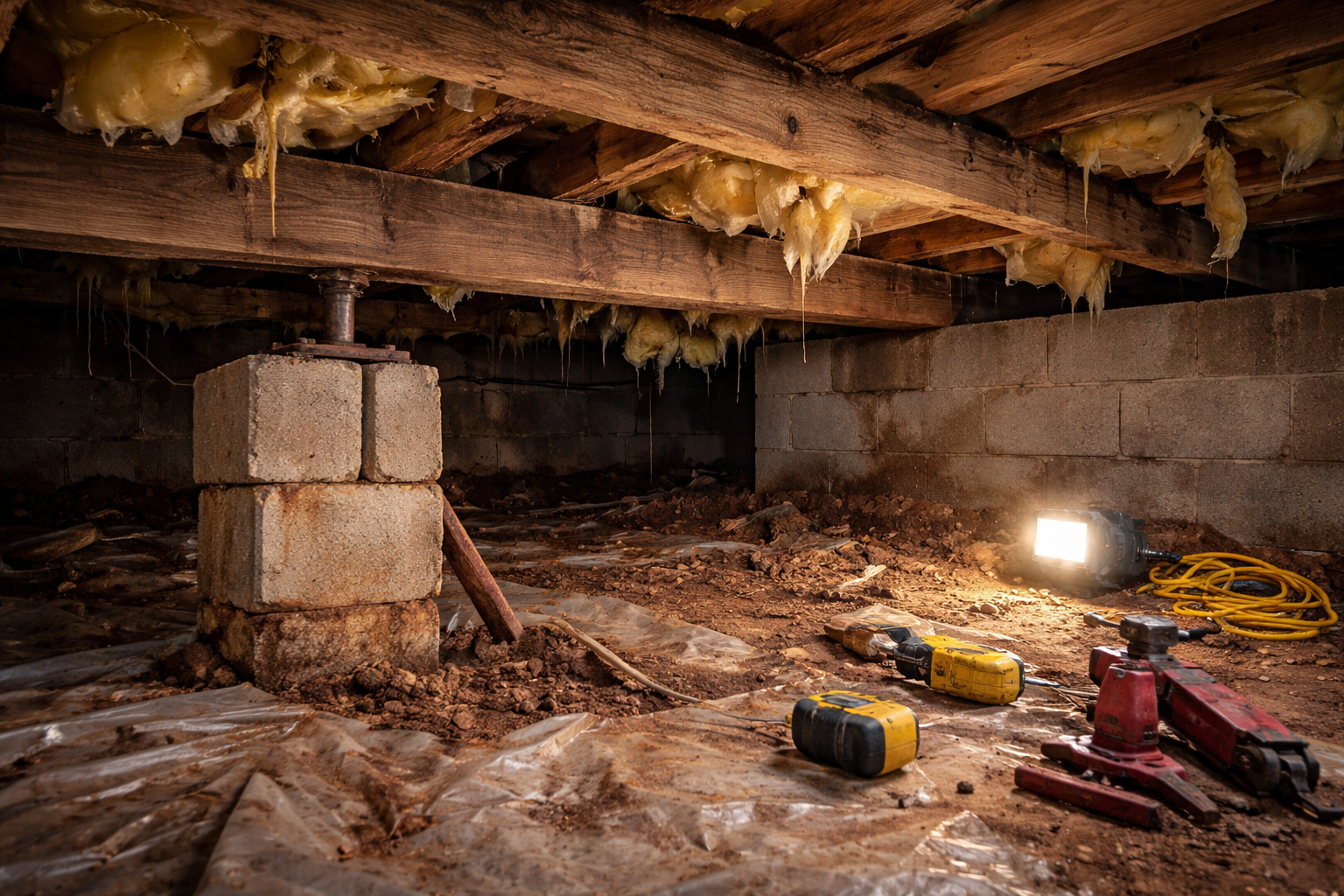
Think of your crawlspace as the unseen foundation of your daily comfort. It’s not just an empty gap under your home — it’s where your structural support system lives. Every step you take, every piece of furniture you place, every load your home carries… it all depends on what’s happening down there.
When things are working properly, you never think about it. Floors feel solid. Everything stays level. Life goes on.
But when something goes wrong in the crawlspace, your floors are usually the first place it shows up.
And more often than not, the root issue is moisture.
Moisture & Mold: The #1 Cause of Crawlspace Damage
Let’s talk honestly for a second — Virginia Beach is humid. Not just “a little damp” humid. We’re talking thick, heavy air for a good portion of the year.
Now imagine that air entering your crawlspace through open vents. That’s how many homes were originally designed — to “breathe.” But in a coastal climate, that idea backfires.
Instead of drying things out, those vents allow humid air to settle into a cooler, shaded space. And when warm, moist air meets cooler surfaces, condensation forms. It’s the same reason your cold drink sweats on a hot day.
Only this time, it’s happening on your floor joists. Your beams. Your subfloor.
Day after day.
Month after month.
Over time, that moisture starts to soak into the wood. Not enough to notice immediately, but enough to begin weakening it. Mold finds its way in. Insulation becomes damp and ineffective. The air gets heavier, mustier.
And slowly, the structure holding your floors up begins to lose its strength.
That’s when floors start to sag. Not all at once — just enough that you feel it.
The Real Fix: Crawlspace Encapsulation
This is where most temporary fixes fall short.
You can’t “dry out” a crawlspace that’s constantly being fed moisture from the outside. You have to stop the source.
That’s what crawlspace encapsulation does.
Instead of letting outside air control the environment, encapsulation seals the crawlspace completely. A heavy-duty vapor barrier lines the ground and walls. Vents are closed off. A dehumidifier regulates the air inside, keeping humidity at a stable, safe level.
It’s a shift from reactive to controlled.
And once moisture is no longer a constant presence, the conditions that cause mold and wood rot begin to disappear.
Weak or Damaged Floor Joists: When Support Starts Failing
Now let’s talk about what actually holds your floors up.
Floor joists are the horizontal beams running beneath your home. They carry the weight of everything above — furniture, appliances, people, daily life.
When they’re strong, your floors feel solid.
But when they’ve been exposed to moisture for years, they don’t stay strong.
They soften. They weaken. Sometimes they even begin to rot.
And when that happens, they can’t distribute weight properly anymore. Certain areas start to dip. Others feel unstable. The entire floor system becomes uneven.
It’s not always obvious from above. But underneath, the difference is clear.
The Solution: Crawlspace Support Systems
This is where structural correction comes in.
Using adjustable support jacks and reinforced beams, crawlspace specialists can stabilize those weakened areas. In many cases, they can even lift sections of the floor back to their original position.
It’s not about patching the surface. It’s about restoring the support system underneath.
Soil Movement: The Hidden Force Beneath Your Home
Sometimes the issue isn’t the wood. It’s the ground beneath it.
Virginia Beach soil is a mix of sand and clay — and both have their quirks. Sand shifts easily. Clay expands when wet and shrinks when dry. Add heavy rain, coastal weather patterns, and time… and you’ve got movement happening below your foundation.
You won’t see it directly. But you’ll feel the effects.
When soil shifts, it doesn’t always do so evenly. One part of your home might settle slightly while another stays in place. That imbalance transfers upward, creating uneven floors.
The Fix: Foundation Stabilization
When soil can’t provide consistent support, the solution is to go deeper.
Push pier systems anchor your home into stable soil layers below the surface. They bypass the shifting upper soil and create a solid base that doesn’t move with seasonal changes.
In some cases, they can even lift parts of the home back into alignment.
Poor Construction & Over-Spanned Flooring
Not every issue comes from damage. Sometimes, it starts with how the home was built.
In some cases, floor joists are spaced too far apart. Or the materials used weren’t quite strong enough to handle long-term load. It might not have caused problems right away — but over time, those small structural compromises begin to show.
Add renovations into the mix — heavier flooring, kitchen islands, added walls — and the original structure can become overwhelmed.
That’s when floors begin to dip simply because they weren’t designed to carry that much weight in the first place.
Free crawl space inspection from us can help you pinpoint the real root cause.
The Solution: Crawlspace Reframing
In more advanced cases, sections of the crawlspace structure need to be rebuilt.
That can involve replacing damaged wood, adjusting joist spacing, or reinforcing the entire support system. It’s detailed, precise work — but it restores the home’s structural integrity from the ground up.
Water Intrusion: The Problem That Speeds Everything Up
If moisture is the slow problem, standing water is the fast one.
Water can enter a crawlspace through poor drainage, groundwater seepage, or heavy storms. Once it’s there, it doesn’t just sit harmlessly. It accelerates everything — mold growth, wood rot, soil instability.
It turns a manageable issue into a serious one much faster than most people expect.
The Fix: Crawlspace Drainage Systems
A proper drainage system doesn’t just remove water — it prevents it from coming back.
With perimeter drains, sump pumps, and exterior water management, you’re actively controlling where water goes instead of letting it collect under your home.
Why Quick Fixes Don’t Work
It’s tempting to look for an easy solution.
Maybe you shim a floor. Patch a crack. Ignore the smell.
And for a while, it feels like the problem is gone.
But it’s not.
Because uneven floors aren’t the issue — they’re the symptom. The real problem is underneath. And until that’s addressed, it will keep coming back in one form or another.
The Right Way to Fix Uneven Floors (Step-by-Step)
Fixing uneven floors the right way isn’t complicated — but it does require the right approach.
It starts with a full crawlspace inspection. Not a guess. Not a quick look. A real assessment of what’s happening underneath your home.
From there, the focus shifts to identifying the root cause. Is it moisture? Structural damage? Soil movement? Sometimes it’s more than one.
Moisture control almost always comes first. Without that, any structural repair is just a temporary fix.
Then comes stabilization — support systems, reframing, or foundation repair depending on the issue.
And finally, long-term protection. Because the goal isn’t just to fix the problem once. It’s to make sure it doesn’t come back.
Why Homeowners Trust Local Crawlspace Experts?
Homes in Virginia Beach face specific challenges. The humidity, the soil conditions, the coastal environment — it all plays a role.
That’s why homeowners often search for crawl space specialists near me instead of general contractors. They want someone who understands not just construction, but local conditions.
Because in this case, context matters.
When Should You Take Action?
If you’ve noticed uneven floors, the best time to act is… now.
Not because your house is about to collapse. But because small problems tend to grow when they’re ignored.
And the earlier you address them, the simpler (and more affordable) the solution usually is.
Are uneven floors always a foundation issue?
Not always. Many times, the problem starts in the crawlspace — moisture, weak joists, or structural imbalance.
Can moisture really cause floors to sag?
Yes. Over time, moisture weakens wood, leading to structural issues and uneven floors.
How do I know what repair I need?
A professional inspection is the only way to know for sure. Different causes require different solutions.
Is this something urgent?
It depends on severity, but it’s always better to address it early before it worsens.
Ready to Fix Your Uneven Floors for Good?
At some point, every homeowner has to decide — ignore the signs, or figure out what’s really going on.
Uneven floors aren’t random. They’re not just “old house quirks.” They’re a signal.
And once you understand what’s causing them, fixing the problem becomes a whole lot clearer.
- Schedule your free inspection
- Get real answers (not guesses)
- And finally feel confident about what’s happening under your home
Because when the structure underneath is solid, everything above it just feels right again.